Digital Holography at Kwangwoon University
Research, artworks and technological development by Prof. Alaric Hamacher — 3D Film Lab, Kwangwoon University
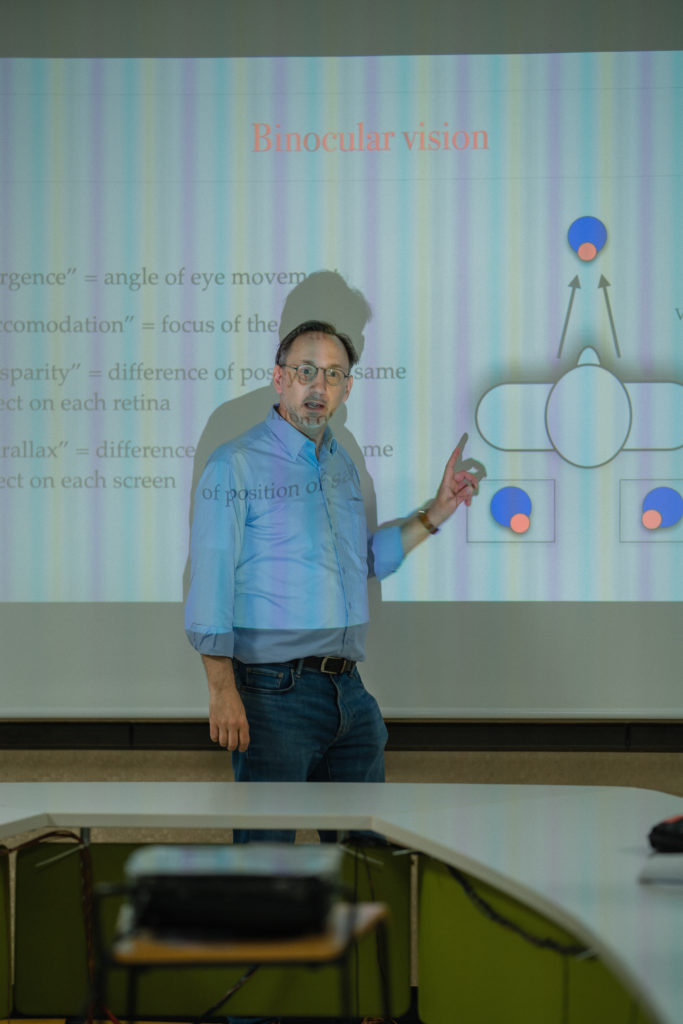
Digital holography is one of the central fields of research and artistic practice at the 3D Film Lab at Kwangwoon University. Prof. Alaric Hamacher works at the intersection of digital holography, stereoscopic imaging, computational imaging, cinematography and emerging spatial display technologies.
The work combines the traditions of stereoscopic photography and cinema with new methods for capturing, generating and displaying three-dimensional images. A particular focus is the creation of full-parallax digital holograms from real people and objects, as well as the development of practical workflows connecting photographic capture, 3D reconstruction, computer graphics and holographic printing.
From Stereoscopic Imaging to Digital Holography
Holography and stereoscopic imaging share a fundamental objective: reproducing the spatial appearance of the real world.
Traditional stereoscopic cinema records two perspectives corresponding approximately to the positions of the human eyes. A full-parallax holographic image requires substantially more spatial information. Instead of presenting only a left and right view, the image must reproduce many different viewing directions so that the observer can move horizontally and vertically and perceive the corresponding changes in perspective.
Hamacher’s research investigates this relationship between stereoscopy, multi-view imaging and holography, with particular attention to how established techniques from cinematography and 3D image production can be extended toward holographic and light-field displays.
Full-Parallax Digital Holograms
A major part of the work at the 3D Film Lab concerns full-parallax digital holography.
Rather than restricting the viewer to a fixed stereoscopic viewpoint, full-parallax holograms reproduce perspective changes in both horizontal and vertical directions. This creates a spatial image that can be observed naturally from different positions without requiring glasses or a head-mounted display.
The research explores the complete production pipeline: photographic acquisition, reconstruction of three-dimensional scenes, generation of multiple perspectives, preparation of holographic image data and the production of physical holographic prints.
This approach also provides an important bridge between traditional holography and contemporary technologies such as photogrammetry, volumetric capture, neural rendering, Gaussian Splatting and light-field displays.
Blue Girl
One of Hamacher’s best-known works in digital holography is Blue Girl, a full-parallax digital holographic portrait.
The work explores how photographic and cinematographic methods can be translated into a holographic image in which the subject is perceived from different viewpoints as the observer moves around the hologram.
Blue Girl has been presented internationally and received recognition in the field of holographic imaging. The physical hologram is part of the permanent holographic exhibition at Kwangwoon University.
The project represents an important continuing research question: How can the visual language and production techniques developed for photography and cinema be transferred to truly spatial images?
Holography from Consumer Cameras
Another direction of the research is making holographic production more accessible.
High-quality holographic content traditionally depends on specialized capture systems and complex production pipelines. Hamacher has investigated workflows in which readily available cameras and computational tools can provide the spatial information required for holographic image production.
This includes experiments using iPhone photography, photogrammetric reconstruction and Blender to create three-dimensional representations from which the large numbers of viewpoints required for a full-parallax hologram can be generated.
The objective is not merely to simplify acquisition. It is to investigate whether holographic image production can become part of a more general digital imaging workflow rather than remaining dependent on highly specialized capture equipment.
Computational Holographic Imaging
Current research increasingly moves beyond the conventional model of rendering a large collection of perspective images with virtual cameras.
A three-dimensional representation already contains spatial information about the relationship between scene points, viewing positions and light rays. This raises the possibility of generating the information required by a holographic or light-field display more directly.
Research at the 3D Film Lab therefore investigates the relationship between:
- digital holography and holographic stereograms
- multi-view and light-field imaging
- photogrammetry and volumetric reconstruction
- Gaussian Splatting and neural scene representations
- ray-based image generation
- glasses-free spatial displays
- computational methods for converting 3D scenes into display-specific spatial imagery
An important objective is to understand how spatial scene information can be mapped efficiently onto the optical and geometrical requirements of different holographic and light-field display systems.
Holography as a Spatial Medium
Digital holography is not only a display technology.
It introduces a fundamentally different relationship between the image, the observer and physical space. In conventional cinema, the camera determines the viewpoint. In stereoscopic cinema, two viewpoints provide binocular depth. In a multi-view, light-field or holographic image, the observer can increasingly determine the viewpoint through physical movement.
This transition from a fixed image toward a spatial image has consequences for cinematography, composition, storytelling and visual perception.
For this reason, the holography research of the 3D Film Lab is closely connected with its work in stereoscopic cinema, spatial media, immersive imaging and virtual production.
Research and Publications
Hamacher’s academic work investigates both the technical and perceptual aspects of digital holography.
Research topics include the relationship between stereoscopic perception and holographic imagery, methods for producing full-parallax holographic content, photographic and computational acquisition techniques, and new approaches for generating imagery for holographic and spatial displays.
This research has been presented and published through international conferences, symposia and peer-reviewed publications in the fields of holography, optics, stereoscopic imaging and immersive media.
International Holography Activities
The work extends beyond laboratory research into international exhibitions and professional exchange.
Hamacher has participated in international holography events and symposia as an artist, researcher, presenter and session chair. These activities connect the 3D Film Lab’s research at Kwangwoon University with the international community working on holographic imaging, holographic printing and emerging spatial-display technologies.
Digital Holography at the 3D Film Lab
The 3D Film Lab at Kwangwoon University approaches digital holography from the perspective of image creation.
Its central question is not only how a holographic display works, but how meaningful spatial images can be captured, constructed, photographed and designed for it.
This brings together more than a century of stereoscopic imaging with contemporary computational methods and emerging display technologies.
The continuing research explores the transition:
- Photography
- Stereoscopic Imaging
- Multi-View Imaging
- Light Fields
- Digital Holography
and investigates how these technologies can develop into practical tools for cinematographers, artists, researchers and spatial-media creators.
Prof. Alaric Hamacher
3D Film Lab — Kwangwoon University, Seoul, Korea
Stereoscopic 3D · Digital Holography · Spatial Imaging · Virtual Production