Professional work in spatial imaging, immersive media, and holographic production
Three-dimensional imaging has been central to my work throughout my career.
I have worked across the evolution of spatial media—from stereoscopic cinema and virtual reality to augmented reality, spatial computing, and digital holography.
My work combines filmmaking, computer graphics, optics, software development, display technology, and human perception to address one fundamental challenge:
How can digital images reproduce the real world with convincing depth?
Rather than treating these technologies as isolated fields, I approach them as parts of one continuous imaging pipeline: capture, reconstruction, processing, presentation, and perception.
The projects described here are based on practical production challenges. They combine hands-on filmmaking and software development with internationally published research.
Digital Holography
Digital holography is one of the most advanced forms of spatial imaging. Unlike conventional stereoscopic displays, a hologram can reproduce continuous motion parallax and allow the viewer to perceive a three-dimensional image from different positions without wearing glasses.
My work focuses on making holographic content creation more practical, understandable, and accessible to filmmakers, artists, and technical creators.
Holography in Your Pocket
Published in Optics Letters in 2025, this project demonstrates that an ordinary iPhone can be used as the starting point for producing a physical full-parallax hologram.
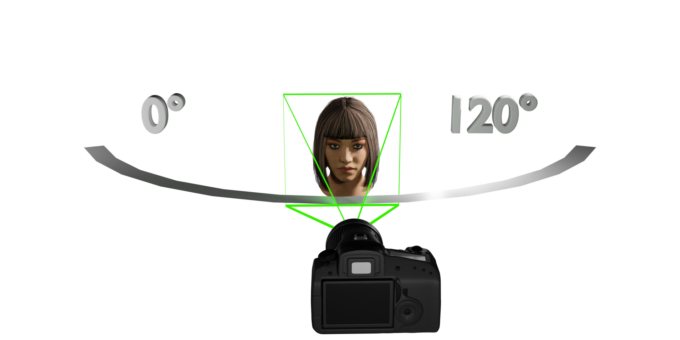
The phone captures both a conventional RGB image and depth information. This data is used to reconstruct a textured three-dimensional model. A virtual camera system then generates the large number of perspectives required for holographic recording.
The resulting full-parallax portraits were recorded on silver-halide material using professional CHIMERA holographic technology.
The project connects consumer mobile imaging with professional hologram production. It reduces the need for complex capture systems and demonstrates a practical route from smartphone depth data to a physical holographic image.
Publication
Alaric Hamacher and Philippe Gentet, “Holography in Your Pocket: Generating Full-Parallax Portraits with an iPhone,” Optics Letters, vol. 50, no. 21, pp. 6710–6713, 2025.
Evaluating Digital Holograms
Producing a hologram is only part of the challenge. A creator must also understand whether the spatial image works correctly for the viewer.
To address this problem, I developed a dedicated method for evaluating stereoscopic and spatial characteristics in digital holography.
The method uses a holographic test chart to examine:
- the position of the holographic image plane
- foreground and background depth
- horizontal and vertical parallax
- viewing position
- occlusion
- spatial composition
- viewer comfort
This work transfers practical knowledge from stereoscopic filmmaking and multiview imaging into holographic production.
It helps explain why a holographic image succeeds or fails—not only as an optical reconstruction, but as a visual experience.
Publication
Alaric Hamacher, “Evaluation of Stereoscopy in Digital Holography,” International Journal of Engineering Trends and Technology, vol. 70, no. 12, pp. 345–350, 2022.
International Symposium on Display Holography
An earlier stage of the iPhone holography workflow was presented at the 12th International Symposium on Display Holography in Seoul in 2023.
The presentation introduced the use of smartphone imaging and depth sensing as a practical source for holographic image generation.
This work brought together mobile capture, three-dimensional reconstruction, multiview rendering, and professional holographic recording in a single production process.
From Stereoscopic Cinema to Spatial Displays
My work in holography developed from long-term experience with stereoscopic filmmaking and immersive displays.
The same fundamental questions appear across cinema, virtual reality, augmented reality, and holography:
- How should depth be composed?
- Where should the image plane be placed?
- How much parallax can be presented comfortably?
- How should camera geometry change for each display?
- How does the viewer perceive scale, distance, and volume?
Understanding these principles across different media makes it possible to design better capture systems, more effective software, and more convincing spatial images.
Virtual Reality and Head-Mounted Displays
My virtual-reality work investigates how stereoscopic production changes when images are viewed inside head-mounted displays.
Stereoscopy in Virtual Reality
This work compares stereoscopic presentation in virtual-reality headsets with stereoscopic cinema and 3D television.
Head-mounted displays create different perceptual conditions through their field of view, optics, display position, image scale, and close relationship to the viewer’s head movement.
As a result, stereoscopic material designed for cinema or television cannot always be transferred directly to VR. Camera configuration, depth range, convergence, and composition must be adapted to the headset.
Publication
Alaric Hamacher, “Stereoscopy in Virtual Reality,” International Journal of Engineering Trends and Technology, vol. 69, no. 6, pp. 126–130, 2021.
Smartphone Head-Mounted Displays
My work on smartphone-based VR examined how inexpensive head-mounted displays affect stereoscopic depth perception.
The project investigated image scale, optical configuration, perceived depth, and visual discomfort, with the goal of adapting existing stereoscopic content for mobile VR viewing.
Publication
Alaric Hamacher, Soon-Chul Kwon and Taeg-Keun Whangbo, “Analysis of Depth Perception in Smart Phone HMDs.”
Omnistereo Imaging
I also investigated the production of omnistereoscopic imagery for head-mounted displays using longer focal-length lenses.
This work addressed panoramic capture, stereo-camera geometry, viewing direction, image stitching, and the relationship between camera configuration and perceived depth.
Publication
Alaric Hamacher, Soon-Chul Kwon, Taeg-Keun Whangbo and Seunghyun Lee, “Study on Making Omnistereo Images for HMD Using Longer Focal Length,” International Conference on 3D Imaging, 2015, pp. 1–5.
Augmented Reality and Spatial Interaction
Spatial imaging is not limited to image presentation. It also changes the way users interact with digital information.
Augmented Reality User Interface Evaluation
This project compared interaction performance using Microsoft HoloLens, Epson Moverio, and conventional mouse input.
The work evaluated input speed, accuracy, usability, and interaction efficiency across different augmented-reality systems.
Its purpose was to establish a practical method for comparing emerging spatial interfaces with conventional desktop interaction.
Publication
Alaric Hamacher, Jahanzeb Hafeez, Roland Csizmazia and Taeg-Keun Whangbo, “Augmented Reality User Interface Evaluation: Performance Measurement of HoloLens, Moverio and Mouse Input,” International Journal of Interactive Mobile Technologies, vol. 13, no. 3, pp. 95–107, 2019.
Virtual, Augmented and Mixed Reality in Medicine
My work has also explored how immersive visualization can contribute to medical training, simulation, communication, and treatment.
Application of Virtual, Augmented, and Mixed Reality to Urology
This interdisciplinary work examined the use of immersive technology for surgical visualization, simulation, telesurgery, telementoring, rehabilitation, biofeedback, and medical education.
It demonstrated how spatial media techniques developed for entertainment and visualization can also support professional decision-making and clinical training.
Publication
Alaric Hamacher, Su Jin Kim, Sung Tae Cho, Sunil Pardeshi, Seung Hyun Lee, Sung-Jong Eun and Taeg-Keun Whangbo, “Application of Virtual, Augmented, and Mixed Reality to Urology,” International Neurourology Journal, vol. 20, no. 3, pp. 172–181, 2016.
Virtual Reality and Simulation for Progressive Treatments in Urology
This later work continued the investigation of virtual environments and simulation systems for professional training, patient care, and progressive treatment methods.
Publication
Alaric Hamacher, Taeg-Keun Whangbo, Su Jin Kim and Kyung Jin Chung, “Virtual Reality and Simulation for Progressive Treatments in Urology,” International Neurourology Journal, 2018.
One Continuous Field of Expertise
My work follows a continuous development:
Stereoscopic filmmaking → head-mounted displays → virtual reality → augmented reality → spatial computing → digital holography
These are not separate interests. They are different stages of the same effort to understand and create convincing three-dimensional images.
Working across the complete pipeline has given me practical experience in:
- stereoscopic camera systems
- depth composition
- multiview image generation
- head-mounted displays
- virtual and augmented reality
- spatial interfaces
- three-dimensional reconstruction
- digital hologram generation
- display evaluation
- software and workflow development
My work is driven by production rather than theory alone. The objective is to turn advanced spatial-imaging technologies into tools that filmmakers, artists, engineers, researchers, and companies can use in real projects.
Selected Publications
- Holography in Your Pocket: Generating Full-Parallax Portraits with an iPhone — Optics Letters, 2025
- Evaluation of Stereoscopy in Digital Holography — 2022
- Stereoscopy in Virtual Reality — 2021
- Augmented Reality User Interface Evaluation — 2019
- Virtual Reality and Simulation for Progressive Treatments in Urology — 2018
- Application of Virtual, Augmented, and Mixed Reality to Urology — 2016
- Analysis of Depth Perception in Smart Phone HMDs
- Study on Making Omnistereo Images for HMD Using Longer Focal Length — 2015
Complete publication record:
ORCID 0000-0002-9567-5574