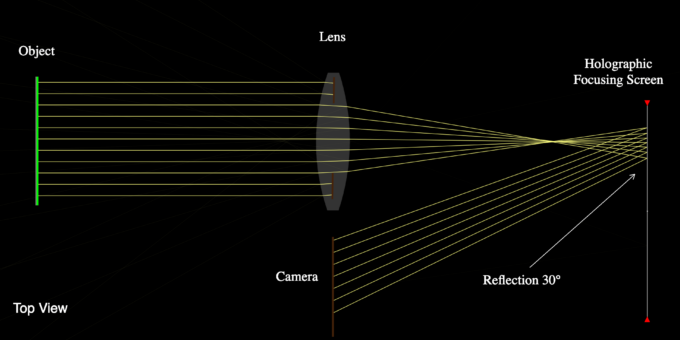
Our lab experiments if a holographic optical element (HOE) could replace the conventional ground glass used for focusing in a large-format camera.
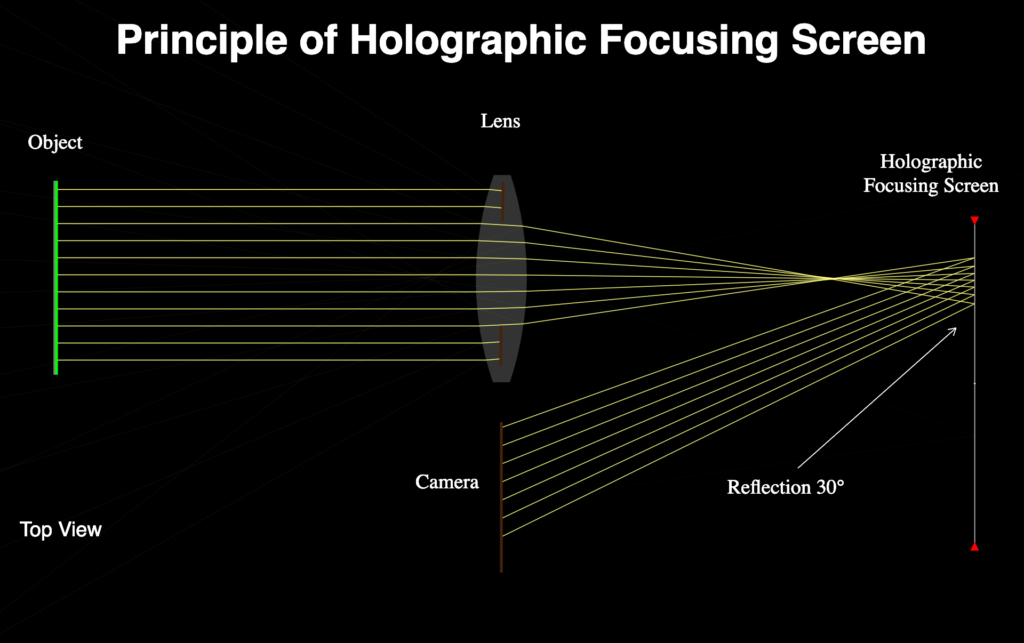
A ground glass provides a visible image plane behind the camera lens, allowing the photographer to compose and focus before recording the image. In practice, however, the image on the ground glass can be dim, low in contrast, and difficult to photograph or integrate into a compact camera body.
A holographic focusing screen could preserve the optical function of the ground glass while allowing the focusing surface to be placed at a different angle. The holographic element would be designed to reconstruct the required focusing wavefront and redirect it toward the photographer or viewing camera.
The following photographs document the ordinary ground-glass image and the practical difficulty of capturing it with another camera. They are part of the visual motivation for investigating a thinner and more adaptable optical element.
This is a theoretical optical experiment rather than a finished product. Its purpose is to investigate how holographic optical elements might help redesign the focusing system of large-format cameras.
Read the complete experiment: https://spatialmedia.dev/articles/holographic-optical-elements-focusing-screen/holographic-optical-elements-focusing-screen.html
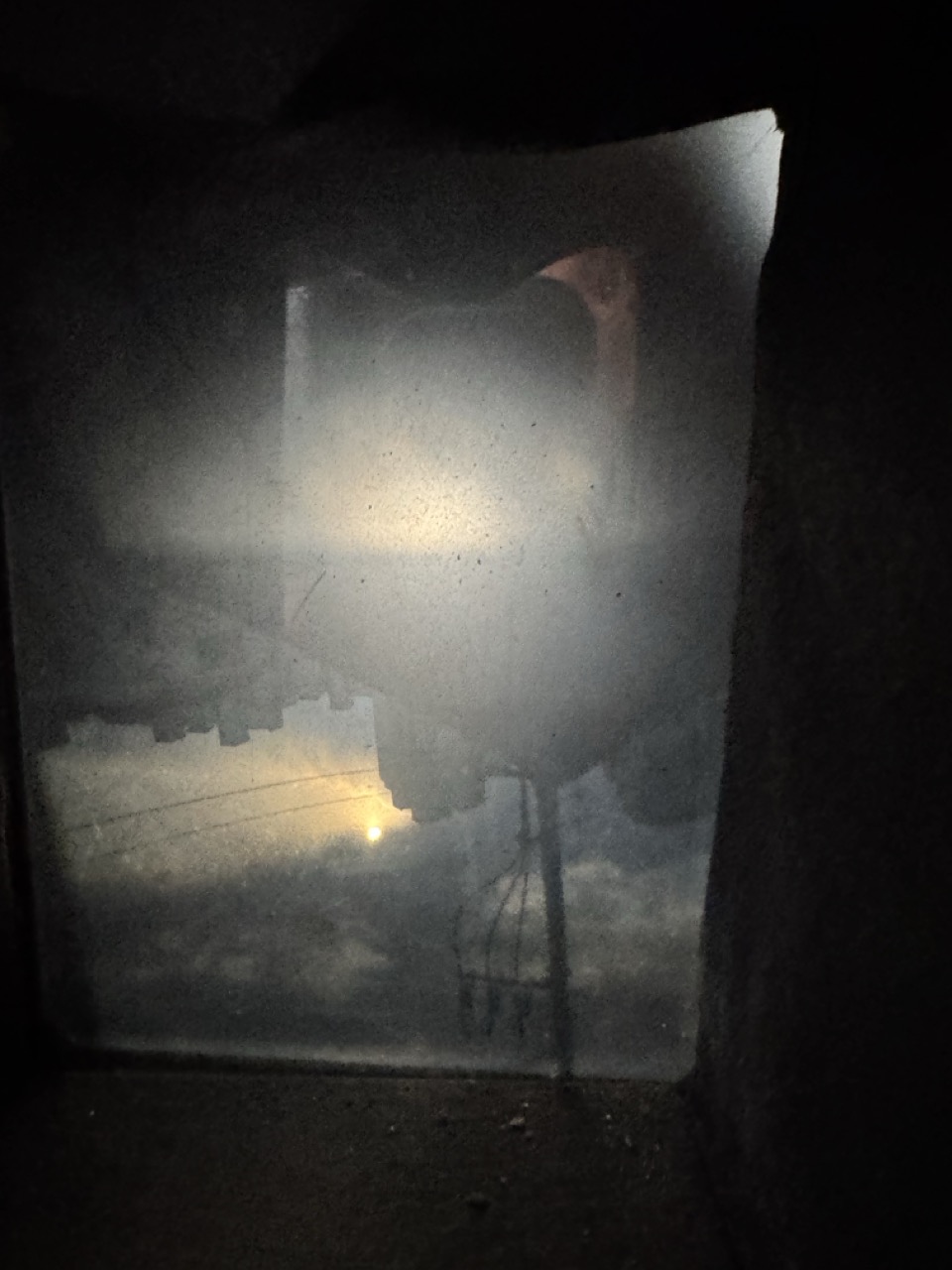
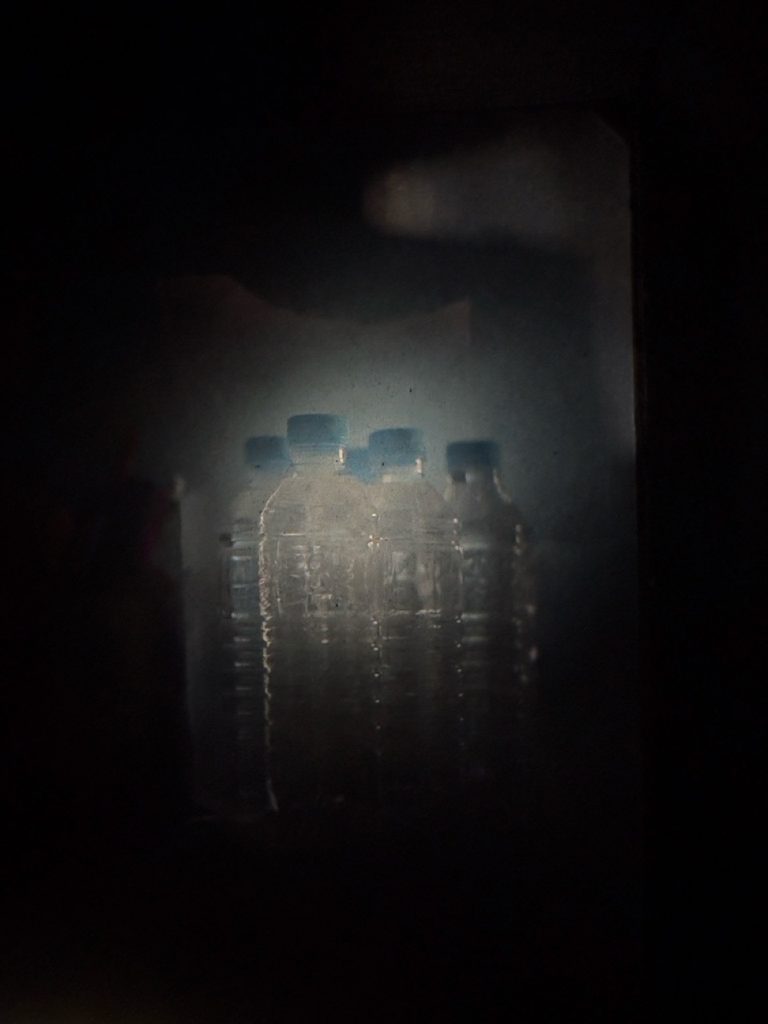
the above fotos show the beautiful shallow depth of field resulting form the large format ground glass. However strong vignetting and structure artifacts make these pictures difficult to use.